OTT Question Time Online

OTT Question Time Online is our weekly debate show on Thursday afternoons where we explore the future of television with broadcasters, film studios, service providers, vendors and analysts from all over the world. 

There’s always so much to talk about in the industry! Guests from, among others, the BBC, BBC Studios, Channel 4, Foxtel, Hearst Networks, ITV, Sky, SVT and Warner Bros Discovery, have joined us to discuss everything from advertising models and technology budgets to content discovery, sustainability, and market dynamics across Europe and beyond.

We continue the conversation in person each year at our annual conference, OTT Question Time Live.

Watch all episodes, free and on-demand. And join our mailing list to find out about upcoming sessions. 
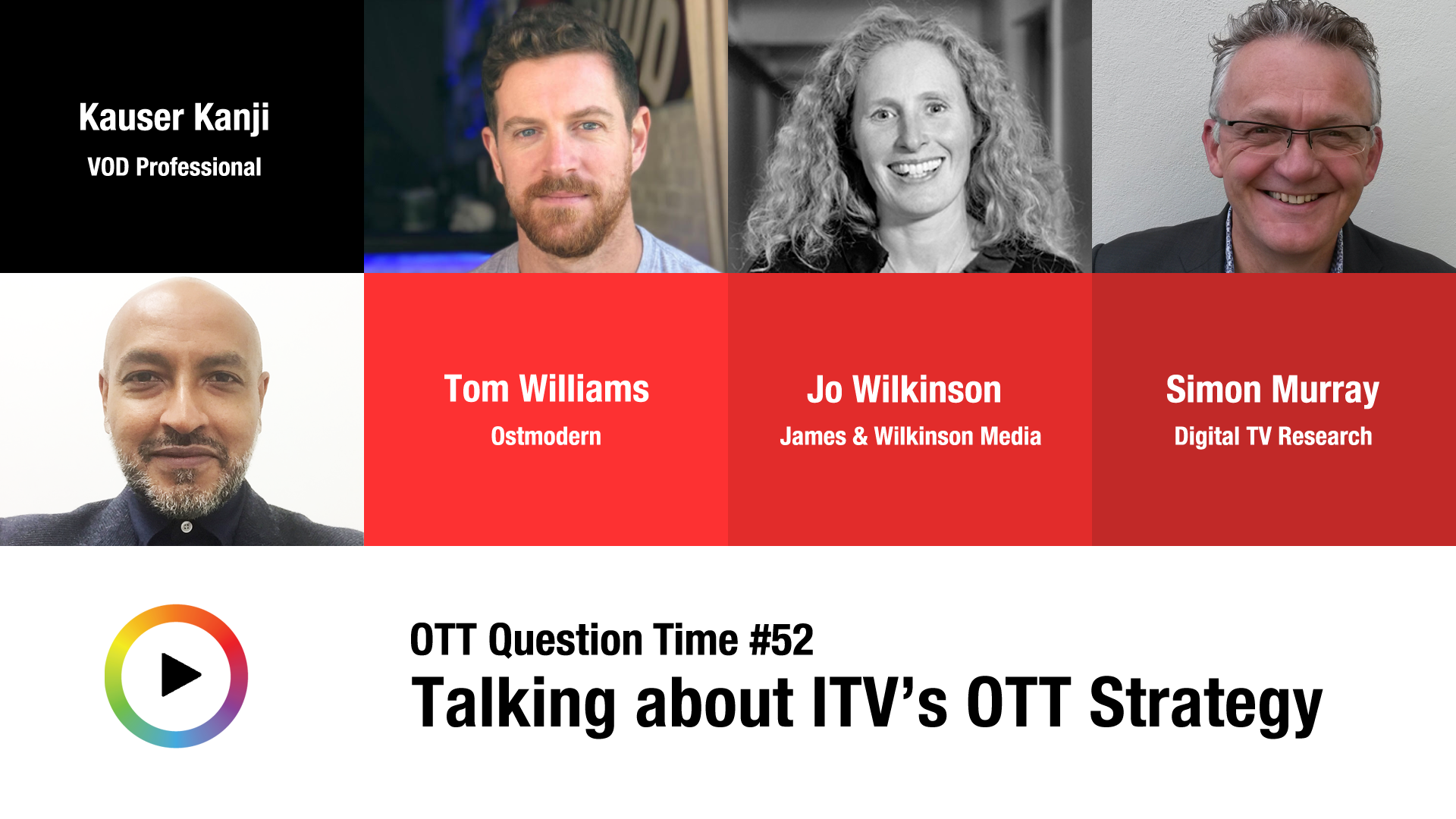
  • OTT Question Time #52 – Talking about ITV’s OTT Strategy

    As a broadcaster, and as an OTT service-provider, ITV is a fascinating company to study and analyse. Sure, it comes with a legacy tech stack but has often been willing to embrace vendor and platform solutions to quickly get to market. It operates using lean teams full of smart people

  • OTT Question Time #51 – The Netflix Effect on OTT

    There was a long stretch of time, from around 2012 to 2017, when Netflix was the big buzz term in the OTT industry. Everywhere I went – panels, speeches, conferences – it felt like everyone was talking about it. Netflix the disruptor. Netflix the pioneer. Netflix, both the saviour and

  • OTT Question Time #50 – Is the Great PVOD Experiment Over?

    Over the past couple of years, and whilst the world has been in various shades of lockdown, film studios and distributors have ramped up the number of their titles available to watch via PVOD. Not without some reluctance. A PVOD-First strategy means potentially leaving a lot of money on the

  • OTT Question Time #49 – Preparing to Go D2C

    At this week’s OTT Question Time, Thursday 17 February, 4pm UK, we talked about the broadcasters, films studios and operators all over the world that have decided to launch their own stand-alone OTT services and go direct-to-consumer. These companies may already have dipped their toes in the water by

  • WEBINAR — The OTT Binge-Watching Phenomenon

    If you’ve ever had a Star Wars night on VCR, a Friends fest on DVD, or gotten lost in a Lost box set on Blu-ray, you’ll know that TV and movie binge-watching isn’t a new phenomenon. What’s different now is the wide availability of titles to binge on, the mode

  • OTT Question Time #48 – Innovations in Green OTT Streaming

    If you’re analysing the environmental impact of OTT streaming you can choose to jump down any number of rabbit holes. The most obvious one is how much online video is actually being watched by any given person over the course of, say, a year? And what does that “cost” in

  • OTT Question Time #47 – The Other Streaming Wars

    When we talk about The Streaming Wars who do we think of as the major players? Amazon, Disney and Netflix, undoubtedly, but also, given its huge customer base and deep pockets, Apple TV+? And surely Sky too as a trusted, multi-territory brand with bags of experience? But outside of this

  • OTT Question Time #46 – Sky Glass

    Sky’s launch, last month, of Sky Glass – the company’s new Smart TV – was celebrated in both the trade and national press. For consumers, Sky Glass offered the chance to subscribe to Sky TV without the need for a satellite dish or a separate set-top box. For the industry,

  • OTT Question Time #45 – Germany OTT Special

    At this week’s OTT Question Time, Thursday 28 October, we went to Germany! Not literally, alas, but we discussed the country’s flourishing OTT landscape with a panel of resident experts: Ralph Wagner, CEO of Axinom, the independent media consultant, Anette Schaefer, and Stefan Blickensdörfer, CTO of 3SS.

    Together we explored:

    • Germany’s TV
  • OTT Question Time #44 – Netflix’s Technology Budget

    Netflix’s technology and development budget has gone from $163m in 2010 to a whopping $1.83bn ten years later – an increase of over 1,000%. Certainly, large chunks of this increase can be apportioned to storage, content delivery and staff costs but what are they spending the rest of the money