

Kauser Kanji
VOD Pro
Share
I was in bed most of the weekend, and Monday too, with a cold. And whilst I was mostly sleeping, or reading, I did manage to stream some shows, mainly on the marvel that is Amazon Prime Video. Why “marvel”? For a number of reasons but, just initially, I was trying to imagine the technical architecture that underpins it. It must be complex, labyrinthine, and yet, evidently, it comes together to produce a seamless discovery and viewing experience for consumers.
Well, almost seamless in terms of discovery as I outline below.
Amazon Prime: the One-Stop Shop
Amazon Prime has everything. Everything. It’s like the Ark but instead of two-by-two there’s the whole zoo.
SVOD, AVOD, tiered-SVOD, PVOD, TVOD, PPV. Rent, buy, box sets. Channel subscriptions. FAST. Live TV.
Not all the FAST and not all the live but hey, who does? (Note to self: YouTube? Maybe YouTube. Yeah, okay.)
The challenge Prime has now is around hierarchies, labelling, presentation. Starting back to front:
Presentation
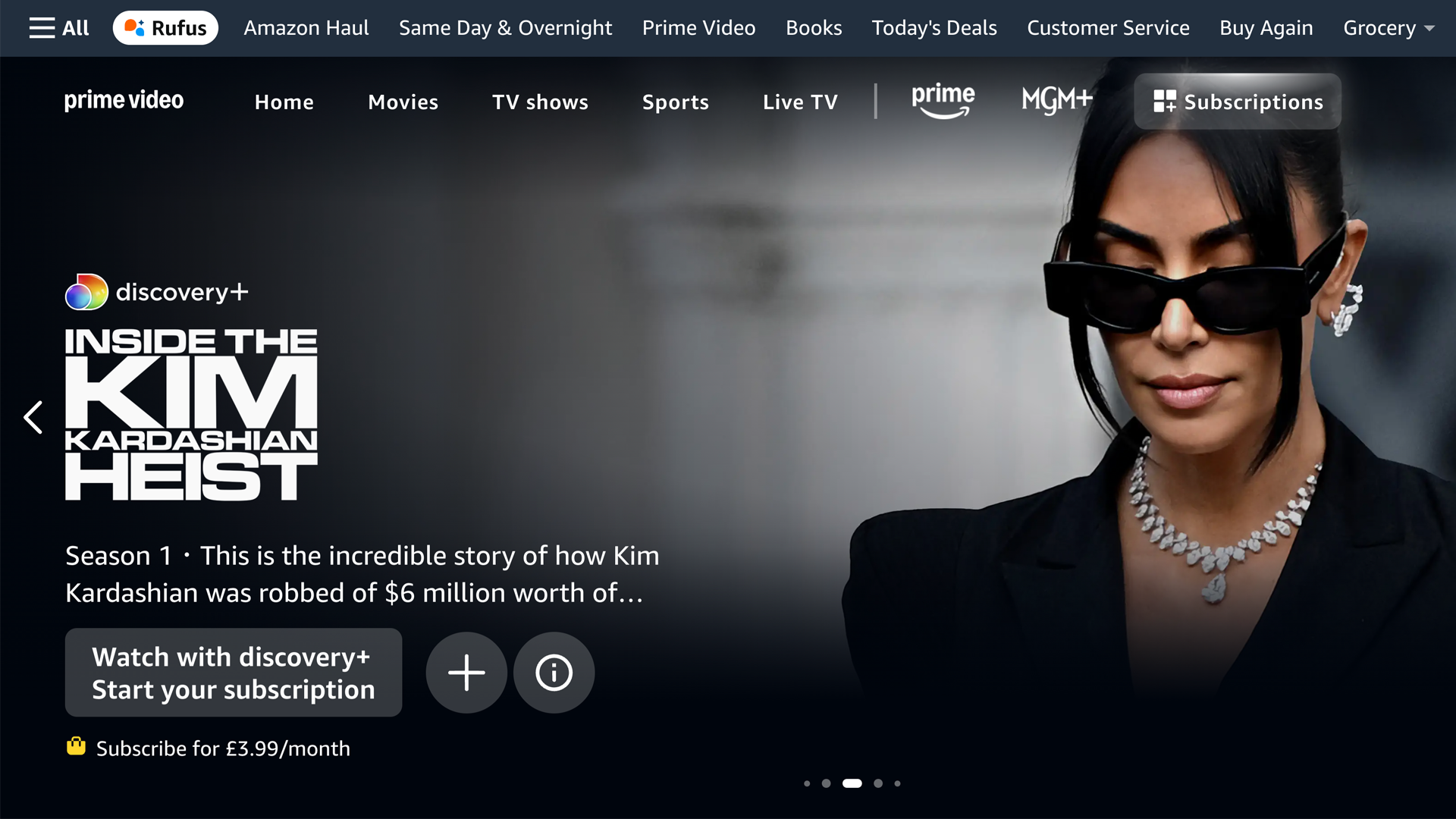
With so many content types, from so many sources, how do you display it so that it makes sense to all the different groups of users (casual browsers through to committed Amazonians)? Prime’s answer seems to be to go all in on rails.
Click on “Subscriptions”, for example, and the page starts with a Hero carousel. Fair. And then lots of rails, a la Netflix, that come in various flavours: Top 10 with Subscriptions; Apple TV+ Most Popular; Crime+Investigation: Recently Added.
It’s good. Topical. Recent. Horizontal.
Problem is all that content, up, down, side to side, gets lost. Who has which shows again? And if there’s an understood ATL/BTL primacy in terms of positioning, there’s surely one on the left-right axis?
And this is Amazon – the uber-lords of recommendation. If you’ve ever read the patent for their recommendation engine, they take this shit seriously for retail. Where’s the super-personalised OTT equivalent?
In a time of incremental growth (the idea of which I’ll revisit in a later post) and incipient paradigm shifts (see below), there are better ways.
Labelling
Movies, TV Shows, Sports, Live TV, Prime, MGM+, Subscriptions. That’s what my top-nav reads and it’s perfectly passable. I am, after all, a linear guy who got used to – since circa 2003 – the world of on-demand. (Via a Homechoice set-top box. It’s now so old/iconic that there’s a Science Museum entry about it.)
But do <25 year olds get it? Sure they do, no?
The labels fit but does the impulse? Because isn’t what you want in the moment the biggest motivation when it comes to watching (content recommendation vendors, feel free to chip in)?
I want a 90-min thriller that will have me on the edge of my seat. I want to binge the latest Bridgerton and live in the past tonight. I want 90-second shorts that kill me emotionally.
If 16-34s are the biggest growth market, they need to be addressed, engaged, served better.
Hierarchies
A few years ago, I was hired by Netflix to conduct a bunch of focus groups in the US. How would the audience react, they wanted to know, if Netflix was voice-controllable?
We arranged what we would end up calling “The Wizard of Oz experiments”. In each case we had a couple, or a family of subjects, in a living room environment: a sofa, chairs, a TV etc.
In Scenario #1, the subjects would address the TV (aka Netflix) with a command. E.g. “play episode 1, House of Cards”. Netflix – yeah, Netflix – would respond with silence but load up and play the episode.
In Scenario #2, the subjects might give a similar command but this time Netflix (my colleague, sitting behind a curtain) would respond by simply repeating the request before commencing playback: “… playing episode 1, House of Cards,”.
In the final, most advanced, scenario, Netflix (my colleague) would respond with a naturalistic conversation (remember, this was in the days that even Siri couldn’t even do that – if, indeed, it can now).
It might go something like this:
[Subjects] Play episode 1 House of Cards
[Netflix] Do you mean episode 1, Season 1, House of Cards?
[Subjects] No, the one where she was about to get out of jail.
[Netflix] Ah, you mean episode 1, Season 2 –
[Subjects] Yeah, that’s the one…
Unsurprisingly, on the request-response-reward matrix we created afterwards (leaning in to Daniel Kahneman), our focus groupies (is that the right word?) favoured Scenario #3.
I tell this story because even within a single service – Netflix – the voice-control workflow was complicated enough to imagine, let alone execute. So what happens when you layer that onto a multi-tenant platform like Prime Video?
Take a simple example. Inside Prime, you might subscribe to ITVX, MGM+, and Paramount+. Using voice control, you say: “Play Mission: Impossible 4.” The movie’s available inside Paramount+’s walled garden. Coincidentally, it’s also just aired on ITV1, so it’s sitting on ITVX. Or you could rent it directly from Prime.
From a revenue perspective, Prime would obviously prefer the rental. So which result should it prioritise? How does it rank or present those options?
The answer to this question, I’m told, is that Amazon aims for the most “friction-free” path to content. If the title is available on a free (or AVOD) platform, and assuming the viewer has the right subscription, that’s the route that Amazon will suggest first. It will then cycle through the other possibilities from Free to Paid, taking the user’s access credentials into account.
Man, I’d love to see that algorithm.
So, Amazon seems to have nailed it. But voice control is a live topic in the industry and is about to become a real thing for OTT. With LLMs now in the mix too, every platform provider will be revisiting their approach (if they aren’t already).
Thoughts? DM me on LinkedIn.
ABOUT KAUSER KANJI
Kauser Kanji has been working in online video for 20 years, formerly at Virgin Media and NBC Universal, and founded VOD Professional in 2011. He has since completed major OTT projects for, amongst others, A+E Networks, the BBC, BBC Studios, Channel 4, DR (Denmark), Liberty Global, Netflix, Sony Pictures, the Swiss Broadcasting Corporation and UKTV. He now writes industry analyses, hosts an online debate show, OTT Question Time, as well as its in-person sister event, OTT Question Time Live.